
Research
Our research is focused on the investigation of fundamental photophysical processes in materials and devices for energy technologies using EPR spectroscopy. By combining several different variants of continuous-wave, transient and pulse EPR spectroscopy with theoretical modelling and simulation, we study the nature and dynamics of photo-induced spin states in photovoltaic and photocatalytic materials. Electrically Detected Magnetic Resonance allows us to extend our studies from materials to fully functional devices.
We also contribute to advancing the EPR technique through improved experiments, data analysis protocols and simulation tools.
Charge separation in organic photovoltaics
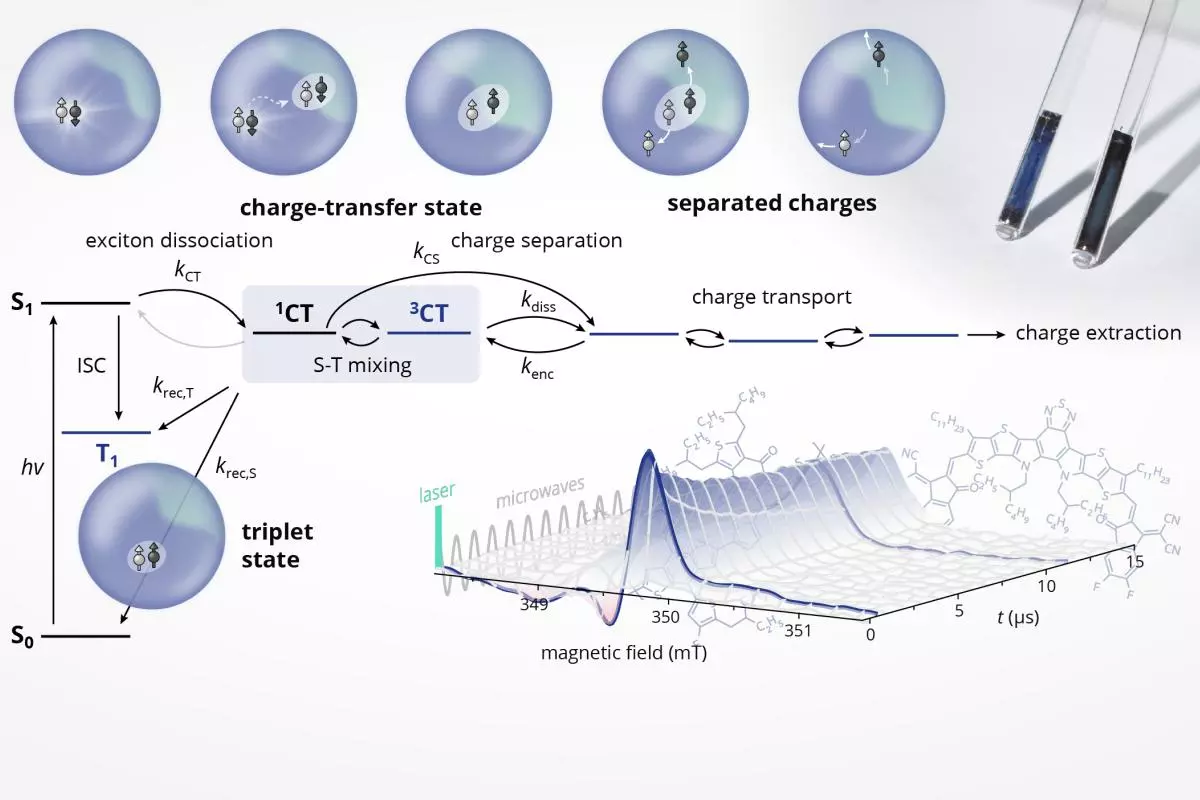
The conversion of solar energy to electricity in organic solar cells relies on photoinduced charge separation at the interface between donor and acceptor domains. The photovoltaic mechanism therefore involves a series of paramagnetic states that can be investigated by EPR: the charge-transfer state, separated charges and triplet states.
We use transient and pulse EPR techniques combined with theoretical simulations and modelling to follow the charge separation process and to characterise the charge-separated states generated in state-of-the-art donor-acceptor blends.
Spin-dependent processes investigated by Electrically Detected Magnetic Resonance
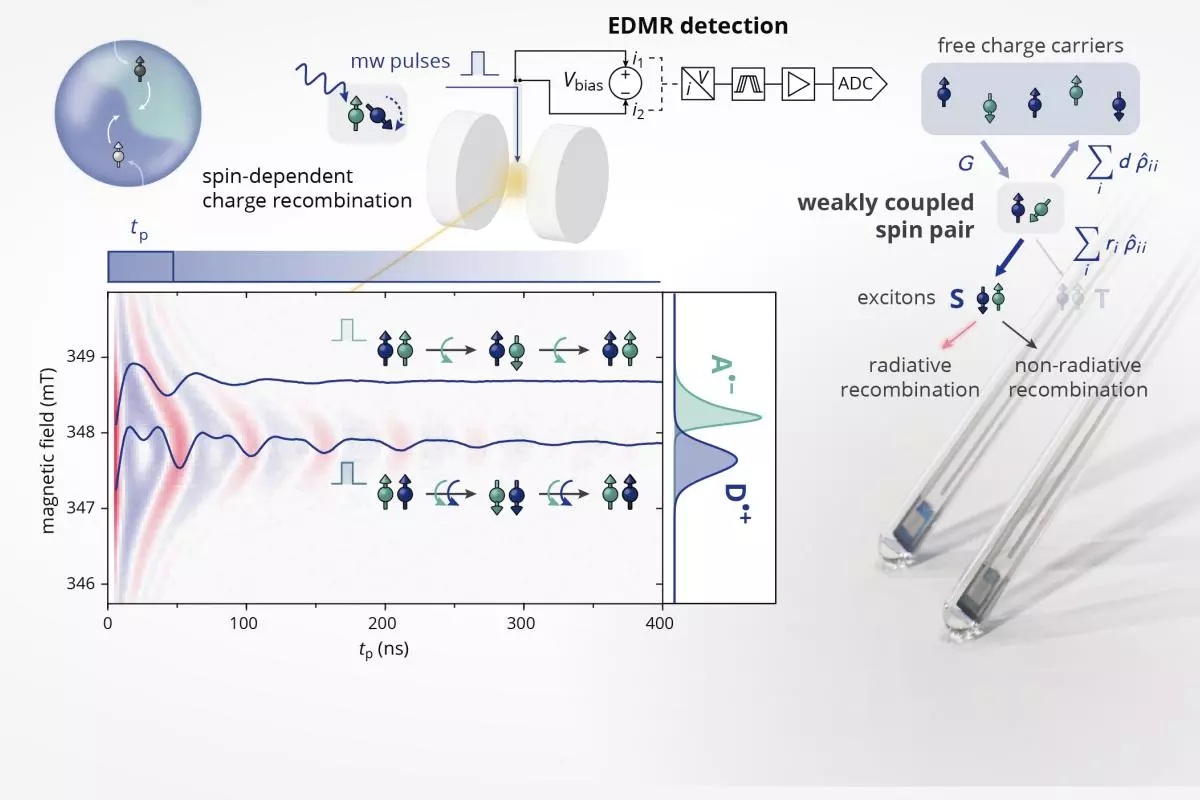
Electrically Detected Magnetic Resonance (EDMR) allows extension of the EPR technique from materials to fully functional devices. Instead of detecting magnetisation, EDMR detects changes in current flowing through a device as a response to microwave excitation.
We build miniature organic solar cells and use EDMR to study spin-dependent processes directly involved in current generation.
Photocatalytic mechanisms in organic semiconductor nanoparticles
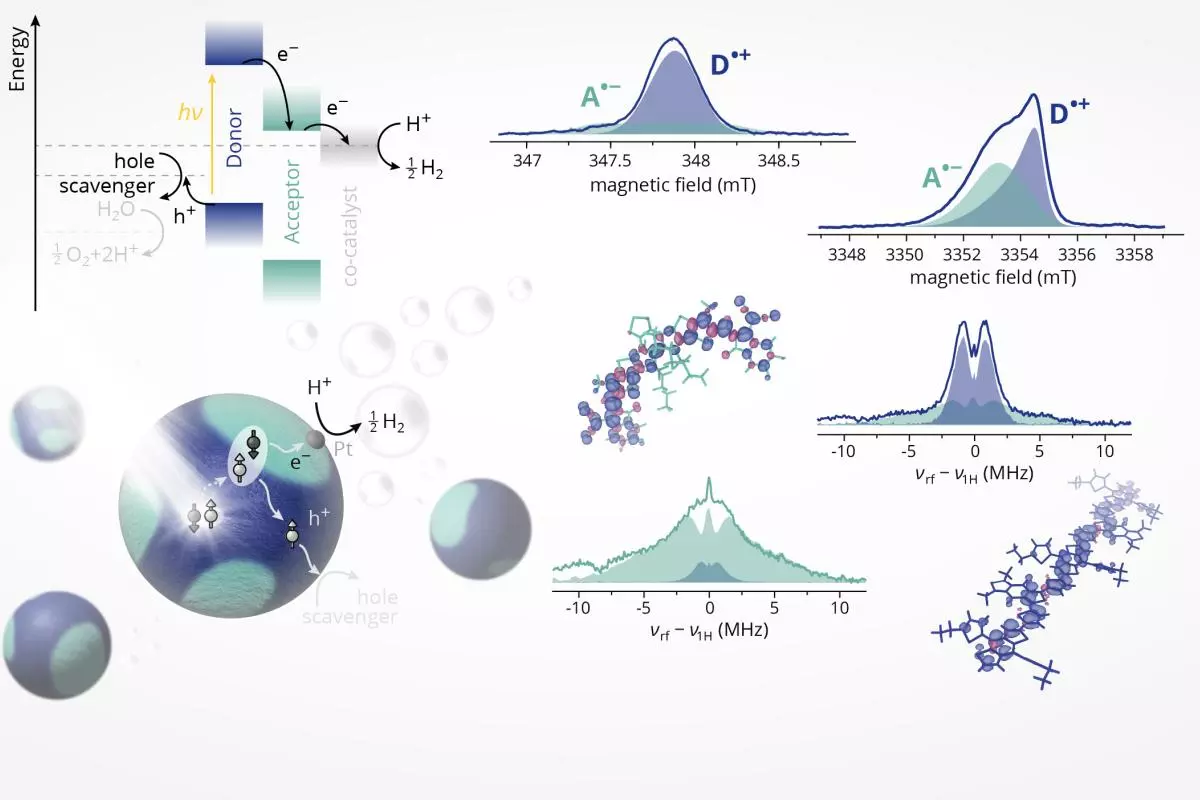
Organic semiconductor bulk heterojunction nanoparticles have been shown to be promising systems for solar-to-fuel conversion. The initial steps of the photocatalytic mechanism mirror the ones in organic photovoltaics, but long-lived charges at the nanoparticle surface are required for efficient photocatalytic conversion.
In collaboration with the group of Iain McCulloch, we investigate photocatalytic mechanisms in donor:acceptor nanoparticles for hydrogen generation. Using a combination of transient and pulse EPR, we study photoinduced spin states, their nanoenvironment and their dynamics.
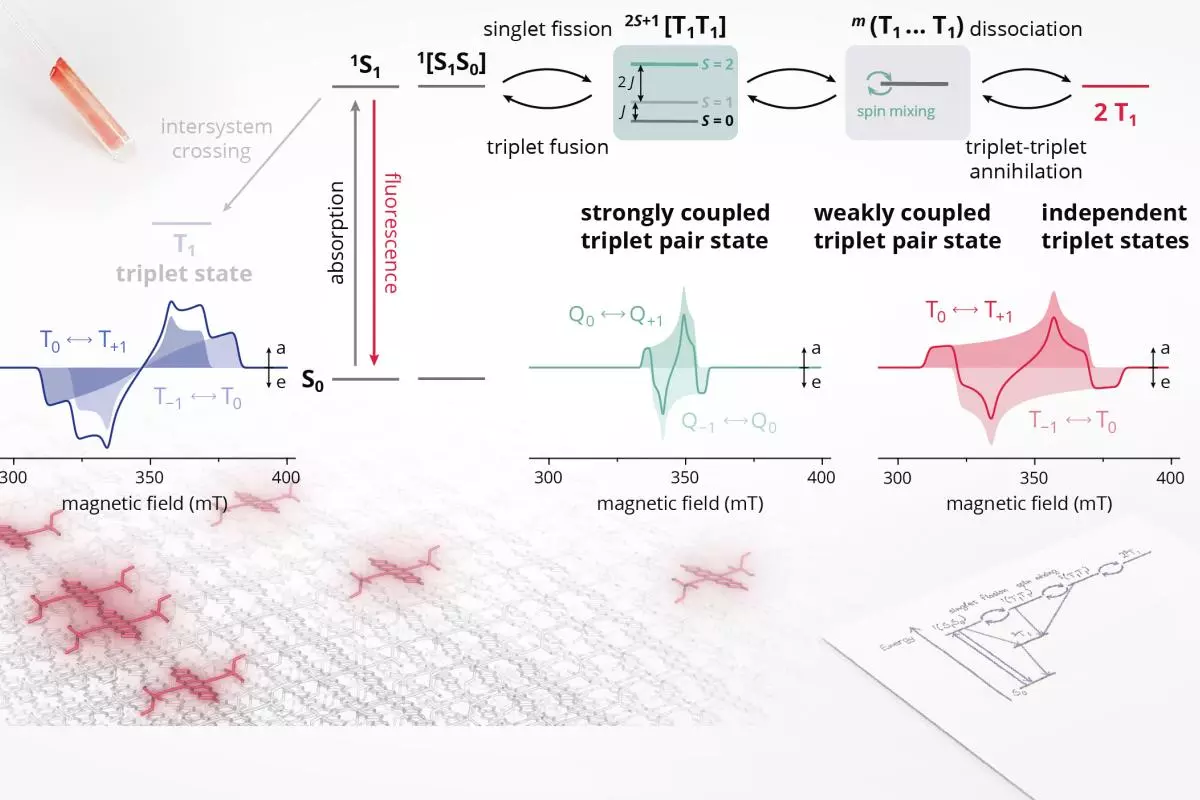
Triplet formation and decay pathways in singlet fission materials
Singlet fission and triplet-triplet annihilation are spin-dependent processes involving the conversion between a high-energy singlet exciton and a pair of low energy triplet excitons. Due to the intricate interplay of spin physics and photophysics, a complete understanding of these processes requires a combination of optical and magnetic resonance spectroscopies.
We collaborate with the group of Jenny Clark to study the different steps of the singlet fission process through transient optical spectroscopy performed as a function of magnetic field to detect the initial photoexcited states and monitor spin mixing and transient EPR measurements for the detection of spin-polarised triplet and quintet states formed in the course of the singlet fission process.
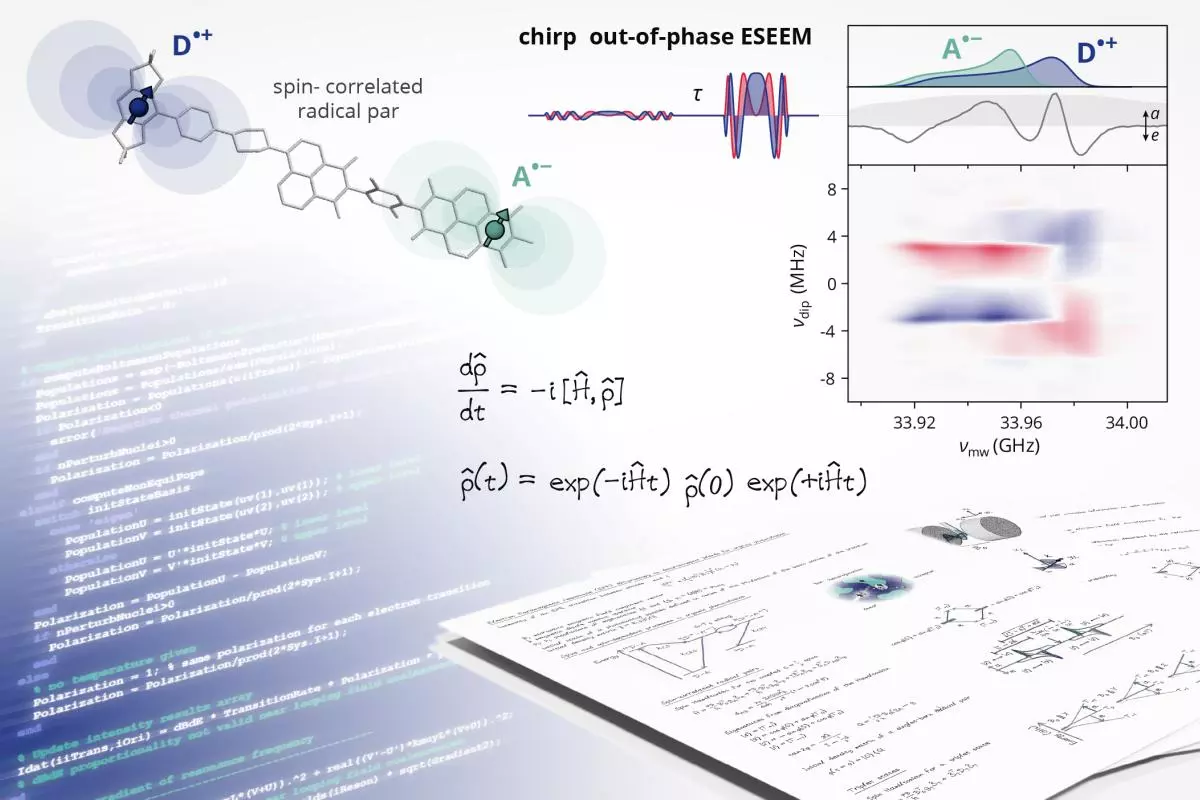
Method development in EPR spectroscopy
Advancements in EPR spectroscopy underpin the ability to address new challenges and gain new insights. We are exploring the use of shaped microwave pulses for the design of pulse EPR experiments with improved sensitivity and information content, focusing in particular on techniques for the characterisation of spin-correlated radical pairs.
We also contribute to the development of improved tools for the simulation of EPR data, which allows us to interpret our experimental results across all projects in terms of the properties of the systems and the fundamental processes we are investigating.